Tuesday, February 24, 2009

The Elfish Gene: Talkin' 'bout my generation...


Of course, the young Mark Barrowcliffe would have rolled his eyes at the reference to The Who song above. One of the most charming passages in this book about growing up geeky and awkward in the '70's is his observation that teenagers are incapable of NOT having an opinion. Everything either sucked or was brilliant. Recently, BBC presenter Robin Lustig spoke at our school. He offered his observations on the international reception of Barack Obama, but the students were mainly interested in the BBC guidelines which forbade him from offering his opinion on the news he reported. How could one function, they wondered, without being able to sound off on every thought that crossed one's mind?

It took a while for me to get into The Elfish Gene. The chatty style of British prose was a turn-off when I lived in the UK in the '80's, and it still grates on me. However, it does not take long to get fully immersed in Barrowclife's obsessive world of gaming. His humor is self-depreciating, and he does a great job of capturing the mental world of a young adolescent who is caught between two elusive goals: fitting in and feeling powerful. Only the world of fantasy roleplaying gives young Spaz the sense of self he craved.

Any modern gamer who picks up this book will see some of themselves in the young narrator. The sense of accomplishment that came from achieving imaginary goals, the ability to argue passionately over some interpretation of rules, the feeling of liberation from the cruel world of adolescence by adopting a fantasy persona. Yet Barrowcliffe out-geeks most of the gamers I've ever known. His insecurities get the best of him and he crosses lines that none of my young gamer friends would ever think to cross. He nearly sets a friend's house on fire when trying to create a "real" fireball. He dives into the occult and actually tries to cast actual spells. Several times, I found myself squirming uncomfortably, pitying the poor young Barrowcliffe.

The author's sense of humor keeps us in the game, however, and his reflections about his own young misperception of the world around him come as surprisingly insightful. Barrowcliffe goes a step too far, in my opinion, by repudiating gaming altogether. He suggests that he would have been happier if he had conformed more to the social expectations of his generation. Barrowcliffe's attitude to gaming clearly crossed the line into addictive behavior, so perhaps this distancing was necessary for him, but one wonders if he would have been less obnoxious if he had chosen sports and girls over dice and character sheets. Low self esteem is low self esteem, after all.

Of course, here I am, a forty-one year old man who still plays role-playing games. But the appeal of gaming that Barrowcliffe describes, the power trips and the escapism, is little more than a distant adolescent memory to me now. Today, I find myself drawn by the social collaborations, the story-telling, and the msytic resonance of the fantasy environment.

Still, there is a tiny part of me, just a tiny part, that wants to ignite a balloon filled with lighter fluid and shout "FIREBALL!!!"

Tuesday, February 17, 2009

Hollow Earth, Part II

Never have I seen an author sell their own work short as I have in this book. The cutsey last paragraph, in which the author mocks True Believers (OK, most of them deserve mocking), misses the big ideas that he had been exploring for the previous 300 pages.

People need a frontier on which to pin their hopes for a better world. The frontier is distant, but it is always attainable to those who are determined. Whether the Hollow Earth represents a new Manifest Destiny, as it did to Symmes in the 19th century, or a utopia, as it did to the Koreshite movement, or simply an escape from a miserable life, as it did to Edgar Rice Burroughs, countless people have seen in the earth what they have most wanted to see.

Else what's a heaven for?

Monday, January 19, 2009

In 113

I got it into my head to write a song for my art history class. At the risk of making a humiliation in front of thirteen students gain a truly global reach, here are the lyrics.

In 113
*to the tune of "Under the Sea" from The Little Mermaid


The artists in ancient Egypt
drew men from the front and side.
Was the pharaoh going or coming?
Who cares? Just enjoy the ride.
Just study the Big 200,
You’ll learn things and then rejoice.
Ace every one of your quizzes,
Four point or multiple choice.

In 113,
Room 113!
Darling it's cooler
Than the whole school here
Take it from me!
We have no anxieties,
Just a naked Hercules.
No time for crammin’
While we be jammin’
In 113!

Hey, Ms Professor Stokstad,
Could you write a little less?
My art book is so damn heavy,
I use it for my bench press.
In class I am always happy--
Relax and enjoy the slides,
temples and great stupas now,
Where the gods live deep inside.

In 113,
Room 113.
In cities Roman
Temples and homes are
With symmetry!
Did you study for the quiz today?
No, so let’s get Rabuck astray.
We’ll hear the stories
‘Bout travel’s glories,
In 133!
-Room 113.
Since life is sweet here
We got the beat here
Naturally
Haigia Sofia’s got a dome
Rabuck’s got a Y chromosome,
It’s all alone there
In his big black chair
In 113!

Friday, January 9, 2009

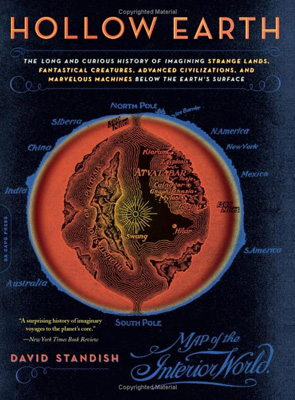
Hollow Earth


I have just finished the first chapter of David Standish's book Hollow Earth (Da Capo: Cambridge, MA, 2006). In it, he explores the persistent belief that our earth contains a subterranean world beneath our feet, tracing the idea's development from the scientific revolution through romantic nationalism all the way to the Utopian religious movements and the pulp novels of Edgar Rice Burroughs that I loved so darn much as a teen.

I was hooked on the book after this line in the intro: "There have been many books recently about important ideas or commodities that have changed the world. This one, I am happy to say, traces the cultural history of an idea that was wrong and changed nothing--but which has nevertheless had an ongoing appeal." (p. 13)

How could you not love a book with that kind of confession at the outset?

Standish belies the self-professed triviality of his subject in the first chapter, however, contrasting Edmund Halley's lauded astronomical contributions to the scientific revolution with his cockamamie assertion of not one but three worlds spinning in the concentric spheres below the earth's outer crust. In each of his many digressions in the careers of Halley's peers, Standish notes the tension between the empirical logic of the early scientists and their reluctance to give up their old Aristotelian views on the nature of the universe. For instance, Halley's belief in the hollow earth came about as a way to explain fluctuations in the earth's magnetic pole, but his assertion that the spheres-within-spheres were inhabited was based purely upon his belief that noting in creation could exist without a purpose.

And for Thomas Burnet, former chaplain to King William III, the hollow earth helped explain where all that water from the flood went to. The rapidly draining flood waters twisted the formerly perfect surface of the earth into the seemingly random land masses that exist today, what Burnet called a "hideous ruin" and our "dirty little planet." (p. 26)

But the emergence of a wrong-headed belief, shrouded in the language of both science and reason, nonetheless speaks volumes about the world of the scientific revolution. There was not some switch Newton threw to dispel all shadows of the medieval mind and bring in the rationality of the enlightenment. Seventeenth century scholars apparently had little difficulty marrying the rational and irrational in their minds. Judging by the persistence of belief in the Hollow World, I would argue that they are not too different from us.

Can't wait for chapter two!

Saturday, January 3, 2009

Holy crap! There's a sequel!

I've been a Jean Shepherd fan since I was old enough to sneak into my parents' bookcase. I love "A Christmas Story," but I sorely miss the American Playhouse version of "The Great American Fourth of July (and other disasters)"--starring a young Matt Dillon, no less. So when I went to look for t on YouTube, not only did I find what I was looking for, but I found the sequel to "Christmas." "My Summer Story," despite using b-list talent rather than c-list, does not have the pop of the original, but, hey, with Shep's narration, I'm willing to forgive a lot.